

The conclusion you may have reached quietly
If intercourse has always been pleasant but rarely the thing that gets you there, you’ve probably drawn a conclusion about yourself. Maybe your body takes the long way. Maybe something’s slightly off. Maybe you just stopped expecting it.
None of that is a diagnosis. It’s what happens when you measure your body against a description that fits a minority of women and was handed to everyone as the default.
Here’s the number that should have been on the first page. In a national US study of 1,055 women aged 18 to 94, 18.4% said intercourse alone was enough for them to climax. That’s fewer than one in five. If you’re not in that group, you’re in the large majority.
What the script assumed
The version most of us absorbed went something like this. Intercourse is the main event, and climax should arrive somewhere inside it. Anything else, whether a hand, a device or a change of position, counts as a warm-up or a workaround.
That story wasn’t invented out of malice. Intercourse is how reproduction works, so it’s what sex education described. It’s also what most on-screen sex shows. A culture that only ever drew one route naturally treated that route as the road.
The script even fits some bodies. For the women in that 18.4%, it describes something real, and nothing here takes that away from them.
The problem is what the script was built around. It was organized around the anatomy that matters for conception, not the anatomy that matters most for pleasure. Those two aren’t in the same place, and that’s where the story starts to come apart.
Where the sensitive structure actually sits
The clitoris is far larger than the part you can see. A 2005 anatomy review led by urologist Helen O’Connell described it as a cluster of erectile tissue: a body, two crura that extend like legs along the pelvic bone, and two bulbs, all arranged around the urethra and the vaginal opening. The review identified the glans, the small tip under the hood, as the only external part of the whole structure, and described it as densely packed with nerves. How that anatomy went missing from textbooks is its own story, told in our post The anatomy was complete in 1844.
Think of a light switch mounted beside a door rather than on it. You can open and close that door all day, and the light only comes on if something actually touches the switch.
That’s roughly the geometry of intercourse. Penetration happens in the vaginal canal, below the glans. It can press on the internal parts of the structure indirectly, which is one reason some women do climax this way. It rarely puts steady, direct contact on the glans, which sits above the vaginal opening and mostly out of the line of motion.
Read with that in mind, the 2018 numbers look less like personal quirks and more like anatomy. In the same study, 36.6% of women said direct clitoral stimulation was necessary for them to climax during intercourse. Another 36% said it wasn’t strictly necessary but made climax better.
The body wasn’t failing the script. The script was aimed at the wrong spot.
Herbenick et al., Journal of Sex & Marital Therapy, 2018 · O’Connell et al., Journal of Urology, 2005
What women were already doing about it
Plenty of women have worked this out on their own, without anyone giving them words for it. A 2021 nationally representative study of 3,017 US women named four techniques women use to make penetration more pleasurable:
- Angling (87.5%): rotating, raising or lowering the hips to change where contact lands inside.
- Shallowing (about 84%): touch just inside the entrance, rather than deep.
- Rocking (about 76%): staying fully inside and moving so the base presses against the clitoris, instead of thrusting in and out.
- Pairing (69.7%): she or a partner stimulates the clitoris with a finger or a device at the same time as penetration.
Two of those four, rocking and pairing, exist to bring the clitoris back into the picture. Women weren’t being difficult or demanding. They were correcting for the geometry.
That’s the practical reading of the 2018 numbers. The gap usually isn’t closed by trying harder or lasting longer. It’s closed by adding the input intercourse leaves out. Pairing is the most direct version of that, and it’s where a small external device earns its place, because it frees both people’s hands and keeps the stimulation steady while bodies are moving.
If the harder part is the conversation with a partner, our post He wasn’t taught either covers why he was likely working from the same missing page.
Hensel et al., PLOS ONE, 2021
Choosing a device by how it works
Most product pages lead with speeds and modes. The more useful question is how the sensation arrives, because that’s what decides whether a device suits your body.
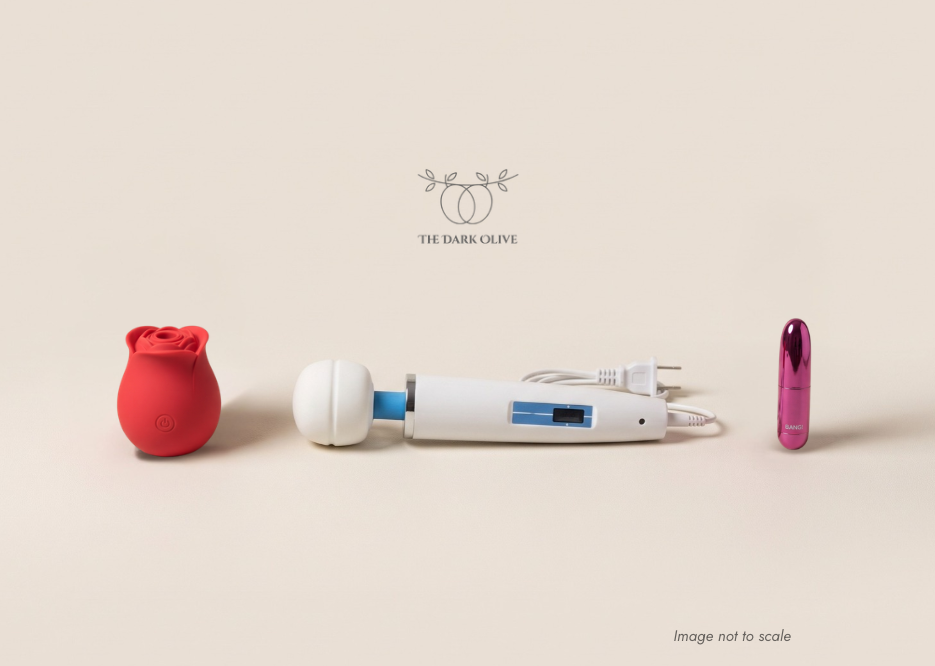
A wand spreads vibration through a large, rounded head. The sensation is broad and diffuse rather than pinpointed, which makes it the gentlest place to start if direct contact has ever felt like too much.
An air-pulse device creates rhythmic changes in air pressure through a small opening. The opening rests around the glans, so the sensation is focused without friction.
A contact device, such as a bullet, concentrates vibration in a small tip. It’s precise, it fits easily between two bodies during partnered sex, and it suits people who already know where they like pressure.
Whichever you choose, start on the lowest setting, since it’s often plenty and you can always go up. Check the material line before anything else, and look for body-safe silicone, glass or metal.
Our External & air-pulse edit is built around exactly this kind of direct external stimulation, with clitoral vibrators, bullets and air-pulse devices in one place. If you’d rather begin with something broader, the Wands are the softer way in.
The other half of the map
For most women, needing direct external stimulation isn’t a preference to apologize for or a phase to grow out of. It’s what the anatomy predicts, and it’s what most women report when someone finally asks. The women in the 18.4% are real, and so is everyone else.
If you’ve spent years thinking you were the exception, you were the majority. The description you were given was the exception.
We’re comparing every mechanism side by side on Instagram this month at @thedarkolive.shop, so save this for when you choose.
Nothing was missing in you. The route was just never drawn.
References
Herbenick D, Fu TC, Arter J, Sanders SA, Dodge B. Women’s experiences with genital touching, sexual pleasure, and orgasm. Journal of Sex & Marital Therapy, 2018.
O’Connell HE, Sanjeevan KV, Hutson JM. Anatomy of the clitoris. Journal of Urology, 2005;174(4):1189–1195.
Hensel DJ, von Hippel CD, Lapage CC, Perkins RH. Women’s techniques for making vaginal penetration more pleasurable. PLOS ONE, 2021. Open access
Herbenick 2018 and Hensel 2021 were conducted in partnership with OMGYES, a sexual-pleasure education company.