

What Is Intimate Wellness? (And Why It’s Not What You Think)
The part of your health that didn’t make the checklist — and why that omission has a cost.
Let’s start with what intimate wellness is not. It’s not a euphemism. It’s not a marketing word invented to make people feel better about buying something. And it’s definitely not a niche concern for a specific type of woman.
Intimate wellness is the part of your overall health that nobody put on the checklist. Not your annual physical. Not your therapist’s intake form. Not the health curriculum you sat through in middle school. It’s a dimension of wellbeing that got quietly left off the list — and the research is increasingly clear that leaving it off has consequences.
So let’s put it back on the list. Here’s what intimate wellness actually means, what the science says about it, and why understanding it is one of the most practical things you can do for yourself.
The Definition Nobody Gave You
Intimate wellness refers to the physical, emotional, and psychological dimensions of your sexual health and your relationship with your own body. It includes how you understand your anatomy, how you experience pleasure, how your body changes across your lifetime, and whether you have access to accurate, shame-free information about all of it.
That last part is where most people get shortchanged.
The World Health Organization defines sexual health as a state of physical, emotional, mental, and social well-being related to sexuality — not merely the absence of disease. That’s a higher bar than most of us were ever taught to set for ourselves. It means intimate wellness isn’t something you either have or don’t have. It’s something you actively maintain — or are actively prevented from maintaining when the information isn’t there.
Source: “Promoting Sexual Well-Being.” Indian Journal of Psychiatry, PMC / NIH (2024). PMC10911331
A 2024 systematic review published by the NIH found that female sexual function is positively correlated with psychological, environmental, social, and overall quality of life — and that sexual satisfaction is inversely linked to depression and anxiety. The connection isn’t incidental. It’s structural.
Source: “Associations Between Sexual Health and Well-Being.” PubMed Central / NIH (2024). PMC11601183
Framing this as wellness — rather than something to be embarrassed about or whispered around — isn’t about softening the subject. It’s about placing it accurately. Your sexual health deserves the same quality of information, the same freedom from shame, and the same investment in products that actually work as any other part of your physical life.
What Intimate Wellness Actually Covers
If you’ve been thinking of this as a narrow category, here’s a more complete map.
Physical health and anatomy
This includes understanding how your body actually works — not the simplified version. The full internal anatomy of the clitoris, for example, wasn’t comprehensively mapped until 1998. If that surprises you, you’re not alone. It’s one of the most cited examples of how late medicine came to taking female anatomy seriously. Knowing your own body — its cycles, its responses, its changes over time — is foundational to everything else.
Pleasure and its documented role in health
Pleasure is not a bonus round. In 2019, the World Association for Sexual Health formally declared sexual pleasure a component of holistic health and wellbeing. A 2023 review published in PubMed Central found that sexual dysfunctions are associated with anxiety, emotional stress, depression, cardiovascular disease, and chronic pelvic pain — which means the inverse also holds: a healthy relationship with your own pleasure has measurable protective effects.
Source: “Sexual Wellness: A Movement Happening Worldwide.” PubMed Central / Revista Brasileira de Ginecologia e Obstetrícia (2023). https://pmc.ncbi.nlm.nih.gov/articles/PMC10748507/.
The products you use and how safe they are
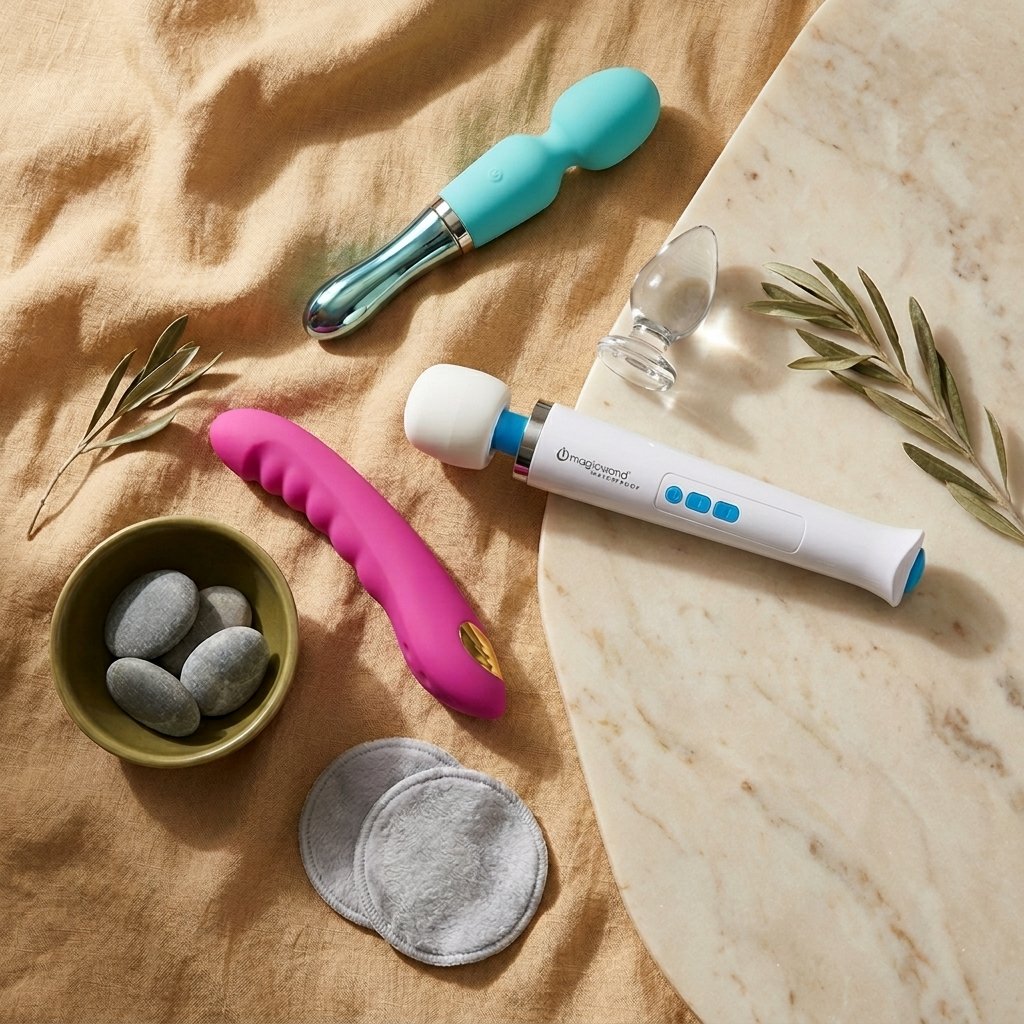
Not all intimate products are made equally, and there are no federal regulations governing the materials used in them the way there are for food, pharmaceuticals, or even children’s toys. Body-safe materials — medical-grade silicone, stainless steel, borosilicate glass — matter for the same reason your skincare ingredients matter. What comes into contact with your body’s most sensitive tissue deserves the same scrutiny as what goes on your face. We cover this in detail in our guide to body-safe materials.
Your emotional and psychological relationship with your body
Shame, misinformation, and cultural conditioning all shape how women experience their own bodies and their sexuality. Intimate wellness includes the work of untangling those messages — not through forced positivity, but through accurate information and a framework that treats your body as something worth understanding rather than something to be managed or contained.
A 2023 systematic review across 14 studies found that sexual functioning has a marker and predictive role in psychological wellbeing — meaning women with healthier sexual lives show measurably better mental health outcomes. The relationship runs in both directions: better information leads to better experience, which leads to better overall health.
Source: “Sexual Health and Psychological Well-Being of Women: A Systematic Review.” PubMed Central (2023). PMC10706599
Why the Language Matters
The words we use to talk about this aren’t neutral.
Language like “adult toys” or “sex stuff” carries decades of cultural baggage — the snicker-at-the-back-of-the-catalog energy that kept these conversations underground and kept most women from ever having them openly. The language of wellness shifts the frame: this is part of your health, not a guilty indulgence.
That shift has practical consequences. Women who approach their sexual health through a wellness lens — with curiosity rather than shame, with information rather than guesswork — report higher satisfaction, stronger self-knowledge, and better outcomes across physical and emotional health markers. The framing isn’t cosmetic. It changes behavior, and behavior changes outcomes.
At The Dark Olive, we use the language of intimate wellness deliberately. Not to make anything sound softer than it is — but because it’s the most accurate description of what we’re actually talking about.
Where to Start
If you’re new to thinking about your intimate health this way, a few honest starting points:
- Start with information, not products. Understanding your own anatomy and how your body responds is the foundation. Everything else builds on that.
- Ask the questions you’ve been embarrassed to ask. The Dark Olive exists specifically for those questions. No judgment — only research and honest answers.
- If you’re curious about products, start simple. Our beginner’s guide to pleasure products is a no-pressure place to start. Every product we carry is body-safe, every description is accurate. Quiz
- Be patient with yourself. Most of us were taught very little about this. Catching up isn’t a sprint — it’s a practice.
The Bottom Line
Intimate wellness is the part of your health that got systematically underfunded, under-researched, under-taught, and over-shamed. That’s not an accident — it’s a pattern with a documented history. And the way out of that pattern is exactly what you’re doing right now: asking questions, reading honestly, and deciding that your own wellbeing is worth taking seriously.
The research is on your side. The WHO is on your side. The World Association for Sexual Health is on your side. The only thing that was ever missing was access to the information — and that’s exactly what The Dark Olive is here to provide.
References & Further Reading
1. “Promoting Sexual Well-Being.” Indian Journal of Psychiatry, PMC / NIH (2024). PMC10911331
2. “Associations Between Sexual Health and Well-Being.” PubMed Central / NIH (2024). PMC11601183
3. “Sexual Wellness: A Movement Happening Worldwide.” PubMed Central / Revista Brasileira de Ginecologia e Obstetrícia (2023). PMC10748507
4. “Sexual Health and Psychological Well-Being of Women: A Systematic Review.” PubMed Central (2023). PMC10706599